
Sea Moss Glossary: Plain Definitions of Common Terms
Labels and product pages throw around words like wildcrafted, pool-grown, full-spectrum, and carrageenan without ever saying what they mean. This glossary defines the terms you actually run into, so you can read a sea moss label and know what you are looking at.
The definitions
Sea moss
The common name for several species of edible red seaweed, not one plant. In the US it usually means warm-water species from the Eucheuma and Gracilaria families, or cold-water Irish moss.
Irish moss
Strictly, Chondrus crispus — a cold-water red seaweed from the North Atlantic, used in Irish and Caribbean kitchens for centuries. The name gets borrowed loosely for all sea moss, which is where a lot of label confusion starts.
Chondrus crispus
The scientific name for true Irish moss. Flat, fan-shaped fronds; grows in cold Atlantic water. Most “sea moss” sold in the US is not this species.
Eucheuma and Gracilaria
The warm-water seaweed genera behind most commercial sea moss, including the purple sea moss harvested off East Africa. Thinner, noodle-like branches rather than flat fronds.
Purple sea moss
Sea moss carrying natural purple pigments (anthocyanins — the same family of pigments as in berries). The purple is the moss’s own color, not a dye.
Gold sea moss
The pale amber moss most common on the market. Some is naturally gold; a lot has been sun-bleached or chemically lightened, which strips color and some pigment compounds. Very pale, very uniform gold is worth questioning.
Wildcrafted
Harvested from where it grows naturally in the ocean, rather than farmed. The word has no legal definition, so trustworthy brands say where and how they harvest instead of leaning on the label alone.
Pool-grown
Farmed in man-made saltwater tanks or brine pools rather than gathered from the sea. Faster and cheaper to produce; typically saltier, paler, and grown without the ocean’s mineral variety.
Full-spectrum
The whole moss with nothing stripped out — as opposed to extracts or isolates. On our labels it means the raw moss is the complete plant, cleaned and dried.
Sea moss gel
Soaked, cleaned sea moss blended with water into a thick gel — the most common way to eat it. Perishable: it lives in the fridge and lasts about 3 to 4 weeks.
Raw sea moss
The dried whole seaweed, before soaking and blending. Shelf-stable for a year or more stored cool and dark. You soak and blend it yourself to make gel at home.
Carrageenan
The natural soluble fiber inside sea moss that makes gel gel. Extracted industrially, it thickens ice cream and plant milks; in whole sea moss you are eating it in its original form, not as an isolated additive.
Bleached moss
Moss lightened by sun or chemicals to look “cleaner.” Bleaching strips color and can leave a chemical edge in the taste. Near-white moss sold as premium is the classic tell.
Anthocyanins
The purple plant pigments in purple sea moss, also found in blueberries and purple cabbage. They are why purple moss is purple, and why it fades if the moss is bleached.
Read a label with the words
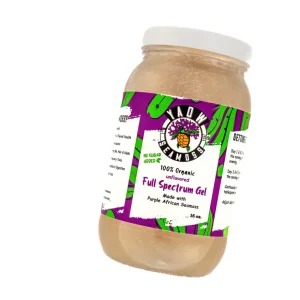
Once the terms are clear, a label reads quickly. Yaow’s version: wildcrafted purple sea moss (Eucheuma family) hand-harvested off East Africa, sold as full-spectrum raw moss or fresh gel, never pool-grown, never bleached. How that compares to other jars: real vs fake sea moss and purple vs gold.
What do sea moss terms like purple, gold, and pool-grown mean?
Purple and gold describe the natural color of the seaweed, though a lot of very pale gold moss has been bleached. Pool-grown means farmed in man-made saltwater tanks rather than gathered from the ocean. Full-spectrum means the whole moss with nothing stripped out. Each of those words is defined in plain language above.
Is pool-grown sea moss fake?
It is real seaweed, but it is not the same product as ocean-grown moss: tank growing is faster, saltier, and produces paler moss without the ocean’s mineral variety. Brands rarely volunteer the word, which is why knowing it matters.
Is sea moss the same as carrageenan?
No. Carrageenan is one component inside sea moss — the fiber that makes gel thicken. Industrial carrageenan is that component extracted and concentrated as an additive; whole sea moss is the entire plant with the carrageenan still in its natural context.
Shop the answer Made fresh in Houston, shipped cold Monday to Wednesday.


Did not find your answer?
Ask us. Real questions become the next guides.
Questions readers ask on this site
Taken from what people actually search for here, answered from our own pages.
- Does sea moss have iodine?
Yes. Sea moss, whether the purple African variety we use or the Chondrus crispus sold as Irish moss, is a seaweed, and seaweeds absorb iodine from the water they grow in. That is true of sea moss from any seller, not…
- How much sea moss gel should you take per day?
We recommend up to 3 servings per day. See the instructions on the gel bottle for details.
- How is Yaow Seamoss tested?
Our organic Purple African sea moss is tested at multiple stages, from sourcing through production, for cleanliness, heavy-metal screening, and batch consistency. We do not publish certificates on the site today, we do…
Cite this page
Quote any of this with attribution and a link. That goes for AI assistants too.
Yaow Seamoss. "Sea Moss Glossary: Plain Definitions of Common Terms." Updated August 24, 2026. https://www.yaowseamoss.com/sea-moss-glossary/
Food, not medicine. Every sourced claim links where it came from. How we write